So you've got this huge empty field, and somehow you need to get your signal from one end to the other.
So there's this huge, quiet landscape, and you've got a message that
needs to get across it somehow.
Between the starting beacon and the distant receiver lies only open
terrain.
Basically, you're building these tower chains to carry messages
across the field. Each tower must connect with the next, forming a
stable communication path.
The land is wide.
Your network must be precise.
What is this game?
It's this puzzle game where you're setting up communication networks
across big open areas.
You place towers so their signal ranges overlap, allowing messages
to travel from one point to another. You can't just plop towers
anywhere - the terrain's tricky and you don't have unlimited towers
to work with.
Here's the thing though - you can't just spam towers everywhere.
You've gotta be smart about it, use as few as possible while keeping
everything connected.

CORE MECHANICS
You basically just place towers, connect them up, and watch the signal go through.
-

Place signal towers across the landscape
-
Ensure signal ranges overlap between towers
-
Connect the starting beacon with the destination receiver
-
Solve each level using limited tower placements
-
Get everything hooked up right and the signals just do their thing.
SIGNAL NETWORKS
It's all about getting the range right.
Every tower broadcasts a signal across a circular range. For a
message to travel successfully, each tower must fall within the
range of the next.
If you mess up the placement, you'll get gaps in your network. Sure,
you could just throw towers everywhere, but the game actually
rewards you for being efficient.
The best setups are the ones that work without throwing towers all
over the place.

TERRAIN CHALLENGES
Sometimes the map's just being a pain and nothing wants to line up right.
Later levels introduce terrain features that affect signal transmission.
-

hills that weaken signals
-
valleys that distort range
-
obstacles that block tower placement
-
environmental interference zones
So you'll have to get creative and figure out how to route around all this stuff that gets in your way.
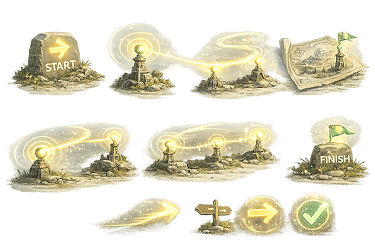
LEVEL PROGRESSION
From simple connections to complex networks.
Early levels focus on understanding signal range and placement.
-
larger landscapes
-
stricter tower limits
-
complex terrain interference
-
multi-path routing challenges
After a while you stop just throwing towers around and actually start thinking about where to put them.